 Book
BookBook · L1 · Catalogued
At the Existentialist Café
Sarah Bakewell
Bakewell narrates existentialism through the lives, arguments, friendships, and conflicts of its major twentieth-century thinkers.
Secular / HumanistModerate448 pages
THE LIBRARY · 662 BOOKS · 232 PODCASTS & EPISODES · 47 COMMUNITIES & DESTINATIONS · 10 MAPS
50 matching resources
BookSarah Bakewell
Bakewell narrates existentialism through the lives, arguments, friendships, and conflicts of its major twentieth-century thinkers.
 Book
BookRoss Gay
Brief daily essays notice delight amid friendship, race, grief, gardens, public life, and ordinary vulnerability.
 Book
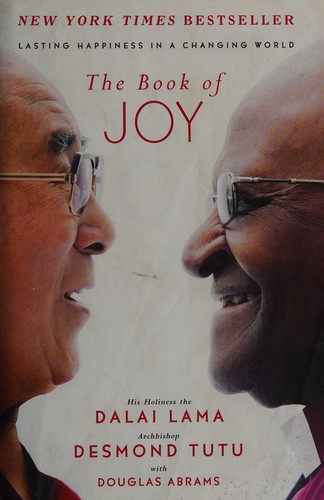
BookDalai Lama XIV; Desmond Tutu; Douglas Abrams
The Dalai Lama and Desmond Tutu discuss joy, suffering, compassion, humor, and practice across Buddhist and Christian lives.
 Book
BookOs Guinness
A Christian account of calling as response to God rather than career fit, achievement, or self-expression.
 Book
BookDavid Whyte
Short poetic essays reopen familiar words such as longing, regret, forgiveness, work, and withdrawal.
 Book
BookPaul Tillich
Tillich interprets courage as the affirmation of being amid anxiety, guilt, meaninglessness, and the threat of nonbeing.
 Book
BookLeo Tolstoy
A short novel in which an ordinary successful life is exposed by illness, fear, isolation, and death.
 Book
BookMary Oliver
A career-spanning poetry collection whose sustained attention to creatures, mortality, wonder, and ordinary life rewards repeated return.
 Book
BookGeorges Bernanos
A novel of an ill, isolated young priest whose apparent failure and hidden grace expose the loneliness of vocation.
 Podcast Episode
Kim I. Mills; Daryl Van Tongeren
Destination-neutral, short, and unusually useful for normalizing both losses and viable nonreligious flourishing.
 Book
BookOliver Burkeman
A humorous philosophical argument for accepting finite time instead of trying to master life through productivity.
BookRichard Rudd
The Gene Keys organizes sixty-four archetypal patterns as movements from Shadow through Gift to Siddhi and connects the book to a birth-data-based personal profile.
 Book
BookMarilynne Robinson
An aging Congregationalist minister writes to his young son about family, race, failure, grace, friendship, and the beauty of ordinary life.
 Book
BookRobert Waldinger and Marc Schulz
Lessons from the Harvard Study of Adult Development center relationships as a major contributor to long-term well-being.
 Book
BookGreg M. Epstein
Humanist chaplain Greg Epstein argues that people do not need belief in God to build ethical, meaningful, and generous lives. He presents Humanism as more than rejecting religion: it can support community, moral responsibility, ritual, wonder, and service while locating their source in human relationships and the natural world.
 Podcast Show
David Ames
The Graceful Atheist Podcast earns a place as secular humanism with explicit respect for people leaving faith; its recurring long-form interview format gives listeners an ongoing way into deconversion and secular grace.
BookSimone Weil
Posthumously selected fragments on necessity, decreation, attention, affliction, beauty, and grace.
 Book
BookParker J. Palmer
Palmer describes practices and circles of trust intended to help people live with greater integrity between inner truth and public life.
 Book
BookRonald Rolheiser
Catholic priest Ronald Rolheiser begins spirituality with human restlessness and desire, then connects that energy with incarnation, prayer, community, justice, sexuality, fidelity, and mortality. Rather than offering a technique, he asks how ordinary longing is gathered into a life and distinguishes spirituality from private intensity or unusual experience.
 Podcast Show
Bart Campolo
A former evangelical minister explores secular meaning, ethics and relationship without making contempt for religious people the price of departure.
 Book
BookSarah Bakewell
A lively history of Humanist efforts to build meaning, ethics, freedom, and solidarity around human life rather than revelation.
 Book
BookRichard Rohr
Richard Rohr uses the image of an immortal diamond to describe the True Self: an identity received in God rather than assembled from achievement, status, religious performance, or self-protection. He contrasts this deeper identity with the False Self, the necessary but limited persona that can become mistaken for the whole person. Through Christian language of death and resurrection, the book invites readers to let constructed identities loosen so that a more loving and connected life can emerge.
 Podcast Episode
Philosophy Bites
A religious philosopher and secular interview format keep meaning open without flattening conviction. This exact conversation earns inclusion because the audio mode performs work a parallel book entry would not.
 Podcast Episode
Michael W. Taft
Cognitive science and meditation meet around how people decide what matters, creating a sideways route from practice to meaning. This exact object earns inclusion because hearing the exchange performs work the 574-book shelf cannot supply as directly.
 Book
BookParker J. Palmer
Parker Palmer approaches vocation as listening for the life that wants to be lived rather than imposing an idealized calling. Through memoir, Quaker-inflected reflection, depression, teaching, limits, failure, and the image of ‘way opening’ and ‘way closing,’ he argues that temperament and constraint may reveal vocation as clearly as aspiration.
 Podcast Show
Krys and Ken
A former worship-leading couple narrates the relational, parental and identity work of leaving Christianity together.
 Podcast Show
Jonathan Bastian
Life Examined earns a place as public-radio philosophy, psychology and meaning; its recurring edited interview format gives listeners an ongoing way into meaning and death.
 Book
BookAlice Roberts & Andrew Copson
Roberts and Copson assemble more than two thousand years of humanist thought through short essays, stories, quotations, meditations, and illustrations. The book moves from human origins and the rejection of religious explanations toward questions of clear thinking, ethical life, happiness, loss, and meaning grounded in reason, shared humanity, and the one life we know we have.
 Book
BookRonald Aronson
Philosopher Ronald Aronson asks how atheists, agnostics, secularists, and the undecided might construct shared meaning after religion rather than defining themselves chiefly through opposition to belief. He explores morality, community, gratitude, hope, responsibility, dependence on others, and humanity's place in nature as resources for a coherent secular orientation.
 Book
BookViktor E. Frankl
Frankl’s book joins two forms: an account of imprisonment in Nazi concentration camps and a concise presentation of logotherapy, his meaning-centered approach to psychotherapy. It explores how people seek purpose through work, love, responsibility, and the stance they take toward unavoidable suffering, while treating meaning as particular to a person and situation rather than as a universal formula.
BookJames R. Doty
Neurosurgeon James Doty translates manifestation into trained attention, emotional regulation, compassion, values, and action. Rather than presenting desire as a force that commands the universe, he asks how the brain filters experience, sustains intention, and helps a person move toward a chosen life.
 Podcast Episode
Hana Baba; Leila Day
Luvvie Ajayi Jones and the hosts connect naming, childhood ridicule and diaspora identity through story rather than definition. This exact object earns inclusion because hearing the exchange performs work the 574-book shelf cannot supply as directly.
 Book
BookKaitlin B. Curtice
Kaitlin Curtice reflects on Potawatomi identity, land, ancestry, motherhood, belonging, and spirituality after formation in white evangelical Christianity. Blending memoir, poetry, history, and prayer, she describes reconnecting with Indigenous identity while discerning what can be carried, healed, or relinquished from Christian inheritance.
 Podcast Episode
On Being with Krista Tippett
Poetry and biography let identity be heard as language made under pressure rather than summarized as theory. This exact conversation earns inclusion because the audio mode performs work a parallel book entry would not.
 Podcast Show
Krista Tippett
On Being with Krista Tippett earns a place as interfaith, philosophical, poetic public conversation; its recurring edited interview format gives listeners an ongoing way into meaning and spirituality.
 Podcast Show
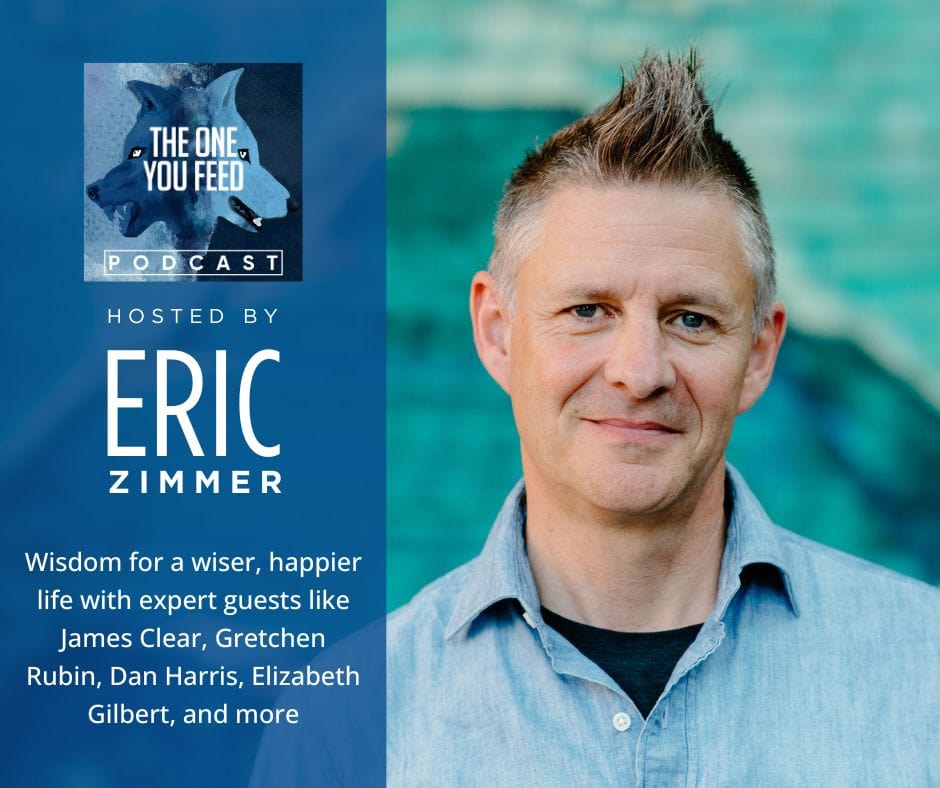
Eric Zimmer
 Book
BookAnnie Dillard
A year of fierce attention to creek life, beauty, predation, perception, and the terrifying abundance of creation.
 Podcast Episode
Pádraig Ó Tuama; Brad Aaron Modlin
Uses the pacing and repetition of Brad Aaron Modlin’s “What You Missed That Day You Were Absent from Fourth Grade” to hold loneliness and self-knowledge in a way prose explanation cannot duplicate.
 Podcast Show
Pádraig Ó Tuama
Uses one poem, read twice with close attention between, as a compact way to encounter grief, identity, conflict, desire, and wonder without requiring doctrinal agreement.
 Book
BookEmily Esfahani Smith
Emily Esfahani Smith organizes research, reporting, and personal stories around four recurring sources of meaning: belonging, purpose, storytelling, and transcendence. Rather than treating happiness as life’s chief measure, she shows how people construct significance through relationships, contribution, the narratives they make of experience, and moments that loosen the boundaries of the self. The book is a humane work of popular psychology and journalism, not a single scientific theory of meaning.
 Podcast Show
Matthias Roberts
BookGabriele Oettingen
Psychologist Gabriele Oettingen explains why pleasant fantasies about a desired future can sometimes reduce the energy needed to reach it. Her method of mental contrasting joins a meaningful wish to its best outcome, the inner obstacle that may interfere, and a concrete plan for responding.
 Book
BookM. Scott Peck
Psychiatrist M. Scott Peck begins with the claim that life is difficult and builds a broad account of maturity through discipline, delayed gratification, responsibility, truthfulness, love, psychotherapy, grace, and spiritual growth. Part clinical reflection, part moral philosophy, and part religious argument, the book helped define late-twentieth-century self-help by presenting psychological health as an ongoing practice of meeting reality rather than escaping pain.
 Community / Destination
The Clergy Project
A screened private online community for current or former professional religious leaders who no longer hold supernatural beliefs.
 Book
BookDavid Brooks
Brooks contrasts achievement-centered ambition with a later life organized around commitment, vocation, relationship, and service.
 Book
BookThomas Merton
Thomas Merton recounts his childhood, education, restless young adulthood, conversion to Catholicism, and entry into the Trappist Abbey of Gethsemani. Written early in his monastic life, the memoir interprets his past through providence, sin, grace, vocation, sacrament, and renunciation, combining literary autobiography with an ardent defense of Catholic faith and contemplative monastic calling.
 Podcast Show
Kim I. Mills
Speaking of Psychology earns a place as research-grounded psychology; its recurring expert interview format gives listeners an ongoing way into psychology and meaning.
 Book
BookJames W. Fowler
James W. Fowler proposes six stages through which the structures of faith may develop, drawing on interviews and structural-developmental psychology. Faith here means the ways people organize meaning, loyalty, identity, and relationship to what they consider ultimate, not simply whether they hold religious beliefs.
 Book
BookPaul Kalanithi
A neurosurgeon facing terminal cancer reflects on medicine, literature, identity, family, and what makes a life meaningful.
 Book
BookAlan Watts
A concise meditation on anxiety, impermanence, and the impossibility of securing life by grasping for certainty.