THE INNER ATLASMy Shelf · 0
Menu

THE LIBRARY · 662 BOOKS · 232 PODCASTS & EPISODES · 47 COMMUNITIES & DESTINATIONS · 10 MAPS

What are you exploring?

Explore the whole Library
Refine resultsFilters applied
Choose only what helps.
TopicsBig Questions
Topic choices
Perspectives
Perspective choices
Effort / Depth
Effort choices
Where Christianity fits

Optional. Choose the closest fit for now.

Not sure? Find your shelf →

288 matching resources

Cover of Advice for Future Corpses (and Those Who Love Them).Book
Book · L2 · Inner Atlas Reviewed

Advice for Future Corpses (and Those Who Love Them)

Sallie Tisdale

Writer, nurse, and Buddhist practitioner Sallie Tisdale offers direct practical counsel for dying and accompanying someone who is dying. She addresses bodies, diagnosis, caregiving, communication, fear, pain, planning, last days, deathbed presence, grief, and the physical handling of a corpse, weaving clinical experience with Buddhist reflection and candid accounts of uncertainty, irritation, tenderness, and the limits of control.

Buddhist — practical mortality reflectionApproachable240 pages
Cover of After: A Doctor Explores What Near-Death Experiences Reveal about Life and Beyond by Bruce Greyson.Book
Book · L2 · Inner Atlas Reviewed

After: A Doctor Explores What Near-Death Experiences Reveal about Life and Beyond

Bruce Greyson

Psychiatrist Bruce Greyson reviews decades of research and clinical encounters involving near-death experiences, including recurring reports of leaving the body, altered time, light, beings, life review, peace, and lasting changes in values. He considers neurological, psychological, and survival interpretations while arguing that the reports deserve disciplined study rather than automatic dismissal.

Psychological / AcademicApproachable272 pages
Decorative; adjacent title and creator provide identity.Book
Book · L2 · Inner Atlas Reviewed

Agnostic: A Spirited Manifesto

Lesley Hazleton

Journalist Lesley Hazleton defends agnosticism as an active stance of intellectual and spiritual openness rather than indecision awaiting a final answer. Blending memoir, history, philosophy, science, and religious observation, she resists both dogmatic belief and dogmatic disbelief, exploring mystery, mortality, awe, doubt, uncertainty, and the human impulse to make certainty protect us from the vulnerability of not knowing.

Secular / Humanist — agnostic memoir and philosophyApproachable224 pages
Cover of Anatheism: Returning to God After God.Book
Book · L2 · Inner Atlas Reviewed

Anatheism: Returning to God After God

Richard Kearney

Philosopher Richard Kearney proposes anatheism—a return to the question of God after both inherited theism and confident atheism have been disrupted. Through philosophy, biblical stories, literature, art, hospitality, and interreligious reflection, he explores encounters with the stranger in which the divine may be received again without restoring the sovereign, certain, or coercive God that critique has made untenable.

Christian — continental philosophical theologyDemanding272 pages
Cover of Being Mortal by Atul Gawande.Book
Book · L2 · Inner Atlas Reviewed

Being Mortal

Atul Gawande

Surgeon and writer Atul Gawande examines how medicine, families, and institutions respond when cure is no longer possible and frailty makes independence harder to sustain. Through patients, clinicians, nursing homes, hospice programs, and his own father’s illness, he explores autonomy, safety, serious-illness conversations, assisted living, risk, caregiving, and the practical question of what makes life worth living near its end.

Psychological / Academic — medicine and ethicsApproachable248 pages
Cover of Being Wrong.Book
Book · L2 · Inner Atlas Reviewed

Being Wrong

Kathryn Schulz

Journalist Kathryn Schulz explores error as a basic human condition whose defining feature is that being wrong usually feels exactly like being right—until the moment a belief breaks against reality. Moving through philosophy, psychology, memory, perception, politics, love, grief, and comic failure, she examines why certainty is seductive, why error threatens identity, and how fallibility can produce curiosity, revision, empathy, and surprise.

Secular / HumanistModerate416 pages
Cover of Being You.Book
Book · L2 · Inner Atlas Reviewed

Being You

Anil Seth

Neuroscientist Anil Seth explains consciousness through the brain's ongoing predictions about the world and the body. Perception, in his account, is a controlled construction constrained by sensory signals; the experienced self is likewise assembled through embodied processes rather than located in a single inner essence. He connects experiments, illusions, clinical cases, and theory while defending biological naturalism.

Psychological / AcademicModerate352 pages
Cover of Belief in God in an Age of Science by John Polkinghorne.Book
Book · L2 · Inner Atlas Reviewed

Belief in God in an Age of Science

John Polkinghorne

Physicist and Anglican priest John Polkinghorne argues that science and theology are distinct but intellectually related searches for truth. Drawing on the intelligibility and relational structure of the physical world, quantum theory, cosmology, divine action, and critical realism, he proposes that Christian belief can be rationally warranted without competing with scientific explanation or being reducible to a proof derived from nature.

Christian — Anglican physicist-theologianModerate133 pages
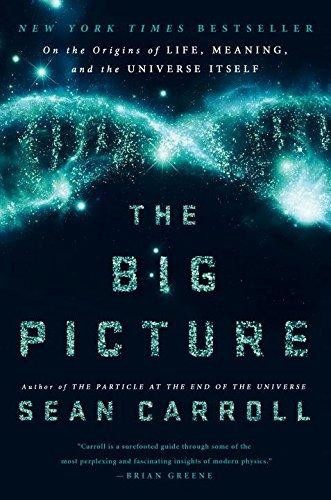
Cover of The Big Picture by Sean Carroll.Book
Book · L2 · Inner Atlas Reviewed

The Big Picture

Sean Carroll

Physicist Sean Carroll moves from quantum fields, cosmology, and emergence to life, consciousness, morality, and meaning. He calls his framework ‘poetic naturalism’: there is one natural world, but multiple vocabularies can truthfully describe its higher-level patterns. The book argues that purpose and value can be constructed and real for human beings without being written into the universe by a supernatural source.

Secular / HumanistModerate470 pages
Decorative; adjacent title and creator provide identity.Book
Book · L2 · Inner Atlas Reviewed

Can a Scientist Believe in Miracles?

Ian Hutchinson

MIT nuclear scientist Ian Hutchinson answers questions students commonly ask about Christianity, science, evidence, miracles, natural law, prayer, consciousness, Genesis, evolution, and the resurrection. Written in a conversational question-and-response form, the book argues that modern science does not require scientism and that belief in divine action can be intellectually responsible when miracles are understood as unusual acts of God rather than violations caused by ignorance.

Christian — physicist and apologetic philosophyModerate288 pages
Cover of The Case for God by Karen ArmstrongBook
Book · L2 · Inner Atlas Reviewed

The Case for God

Karen Armstrong

Historian of religion Karen Armstrong argues that premodern religious language was primarily practical, symbolic, and apophatic rather than a set of literal propositions competing with science. Moving across Judaism, Christianity, Islam, Greek philosophy, mysticism, reform, modernity, and contemporary atheism, she traces how God-talk became increasingly treated as factual explanation and proposes a return to disciplined practice, myth, compassion, and acknowledged unknowing.

Cross-traditional — history of religionModerate406 pages
Decorative; adjacent title and creator provide identity.Book
Book · L2 · Inner Atlas Reviewed

Curveball

Peter Enns

Peter Enns uses memoir, biblical scholarship, humor, and constructive theology to describe faith after inherited explanations of God and Scripture stop accounting for lived experience. Rather than resolving each disruption, he explores how unexpected turns can expose the limits of a tightly managed God and open a less certain, more spacious Christian trust. The book gathers themes from Enns's earlier work into a personal account of change rather than a systematic theology.

Christian — post-evangelical reconstructionApproachable240 pages
Cover of The Demon-Haunted World.Book
Book · L2 · Inner Atlas Reviewed

The Demon-Haunted World

Carl Sagan; Ann Druyan

Astronomer Carl Sagan, with Ann Druyan, defends scientific skepticism as a public discipline for distinguishing well-supported claims from error, fraud, and wishful thinking. Through discussions of UFOs, alien abduction, pseudoscience, education, media, and the history of scientific inquiry, the book develops a ‘baloney detection kit’ while arguing that wonder and rigorous doubt need not be enemies.

Secular / HumanistModerate480 pages
Cover of The Denial of Death.Book
Book · L2 · Inner Atlas Reviewed

The Denial of Death

Ernest Becker

Cultural anthropologist Ernest Becker argues that awareness of mortality creates an existential terror humans manage through symbolic worlds, heroic identities, social status, religion, romance, work, and imagined participation in something enduring. Drawing heavily on psychoanalysis, existential thought, anthropology, and Otto Rank, he interprets personality and culture as organized defenses against creatureliness, vulnerability, dependence, and death.

Psychological / Academic — existential psychologyDemanding315 pages
Cover of Discernment.Book
Book · L2 · Inner Atlas Reviewed

Discernment

Henri J. M. Nouwen

Drawn from Henri Nouwen’s writings and course materials after his death, this volume presents Christian discernment as sustained attention to God through Scripture, prayer, community, desire, memory, relationships, suffering, and events. Rather than promise a private code for extracting divine instructions, it asks readers to notice recurring interior movements and to interpret a life’s direction within practices of patience, gratitude, compassion, and faithful action.

ChristianApproachable160 pages

Showing 60 of 288 resources.