INNER ATLAS MAP
When relief, desire, resistance, and peace do not all point in the same direction.
Ignatian Discernment
Ignatius of Loyola · 16th-century Christian spiritual practice and theological framework
A 9–12 minute walk
Enter the Map ↓01 · BEGIN WITH A FEELING THAT IS HARD TO DISCERN
Jordan has spent a long season mostly on her own.
At first, the distance was needed. Life had become exhausting, and stepping back from people brought relief. Solitude gave Jordan room to recover and hear herself again.
Lately, though, something has shifted. She sometimes misses conversation, shared meals, and being known by other people. An invitation arrives to join a small gathering, and part of her wants to go.
Another part immediately pulls away.
The pull toward community does not feel entirely good. It includes hope, but also vulnerability and discomfort. Staying home feels peaceful—but Jordan cannot tell whether that peace is restoration or retreat.
Which movement leads toward greater life, love, and freedom?
Jordan is a fictional composite.

STAY WITH ONE DISTINCTION
What feels peaceful
and what leads to peace are not always the same.
This Map provides one aid to discernment and choice.
02 · NAME THE MAP, KEEP ITS WORLD
Ignatian discernment asks where interior movement comes from—and where it leads.
Ignatius of Loyola developed a Christian practice of attending to desires, attractions, resistances, thoughts, and feelings without treating any one of them as an automatic message from God.
Two of its central terms are consolation and desolation. They do not simply mean feeling good and feeling bad. They name movements by their direction and fruit.
Does something gradually open a person toward faith, hope, love, freedom, and relationship with God? Or does it close a person toward isolation, despair, self-absorption, or diminished freedom?
This is Jordan’s conflict. Ignatian discernment therefore doesn't decode:
pleasant = consolation
unpleasant = desolation
It teaches the traveler to ask:
What is this movement becoming? Where is it taking me?
03 · TWO WORDS THAT DON’T MEAN FEELING “GOOD” OR “BAD”
Consolation and desolation are about direction.
A movement toward deeper faith, hope, love, freedom, and openness to God and others.
A movement toward isolation, hopelessness, self-enclosure, diminished faith, or loss of freedom.
A difficult movement can still be consolation. Grief, courage, repentance, or costly love may hurt while opening a life.
A pleasant movement can still be desolation. Relief, certainty, or approval may feel good while gradually narrowing freedom or turning someone inward.
LET THE DISTINCTION SETTLE
Do not ask only,
“How does this feel?”
Ask also: “Where is this taking me?”
04 · A PRACTICE SHAPED FOR DISCERNMENT
Ignatius developed these practices for more than reading emotions.
Ignatius of Loyola
Ignatius developed the Spiritual Exercises from conversion, prayer, study, and accompanying others in the Christian life.
A structured retreat
The Exercises use prayer, reflection, imagination, and accompaniment to help a person grow in freedom and become more available to what serves God.
Discernment of spirits
Within the Exercises, Ignatius gives particular attention to consolation and desolation—and to the possibility that something apparently good may still lead away from greater freedom and love.
Go deeper into the historical setting
The first set of rules attends especially to desolation and to people beginning a serious Christian life. The second becomes more exacting about apparent consolation and the possibility of deception “under the appearance of good.” Sections 169–189 place consequential choice inside a larger Christian practice of becoming freer for what serves God.
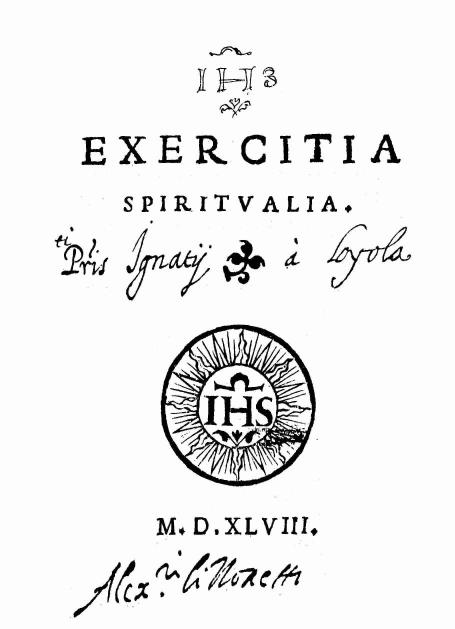
Title page of Ignatius of Loyola’s Exercitia spiritualia. The object anchors the practice in a particular Christian text and history.
Public domain · Wikimedia Commons, “Exercitia Spiritualia 1ed2.jpg”05 · WATCH THE MOVEMENT UNFOLD
One moment rarely tells you where a movement is going.
Ignatian discernment pays attention across time. A movement becomes clearer not simply by how strongly it is felt, but by what it opens, closes, strengthens, or diminishes.
06 · RETURN TO JORDAN
Jordan cannot tell whether staying apart is still giving her life—or beginning to narrow it.
For a long season, stepping back from people had brought needed relief. Lately, Jordan has begun to miss conversation, shared meals, and being known. When an invitation arrives to spend an evening with a small group, both desire and resistance appear.
Rather than treating either feeling as an answer, Jordan watches what happens.
The invitation brings hope, vulnerability, and an urge to withdraw.
Imagining connection sometimes opens warmth and generosity. Imagining staying home brings relief—but Jordan notices that relief can lead either toward needed rest or further enclosure.
Across time, she begins to notice which movements leave her more available to life and relationship, and which leave her increasingly closed.
Neither discomfort nor relief settles the question. Jordan watches what grows from each movement.
Can she imagine either choice without needing one of them to prove something about who she is?
Noticing this pattern or movement gives Jordan a new and legitimate awareness of herself, the factors that compelled her decision, and what future choices could be more life-giving for her.

WHAT THE MAP MAKES VISIBLE
Consolation may be uncomfortable.
Desolation may feel like relief.
The feeling matters. The direction matters more.
07 · ONE TEACHING POINT
One intense moment need not settle a choice.
Ignatian discernment pays attention to movements over time. The Examen, a regular practice of prayerful review, can help a person notice what repeatedly opens toward faith, hope, love, freedom, and relationship—and what repeatedly closes them down.
Context matters. The same feeling may mean different things at different times, and repetition alone does not make a movement trustworthy.
PAUSE · PRIVATE · OPTIONAL
If immediate relief were not the only measure,No answer is required. Nothing is saved.
what else would deserve attention?
08 · FREEDOM INCLUDES EXAMINING ATTACHMENT
Ignatian indifference does not mean not caring.
It means becoming freer to notice when a desired outcome has become so important that other truth can no longer be heard.
A person may deeply prefer one choice. Ignatian discernment does not require pretending otherwise. It asks whether status, fear, approval, certainty, or attachment to a particular outcome has begun choosing on the person's behalf.
Which outcome feels impossible to question?
For Ignatius that may reveal an attachment, not a divine answer.
09 · AUTHORITY AND SAFEGUARDING
Interior movement is not private infallibility.
A feeling does not certify God’s will.
Trauma responses, anxiety, depression, habit, social pressure, desire, prejudice, and material conditions can shape what feels expansive or constricting.
Spiritual language can also be misused.
“Consolation” must not reward compliance. “Desolation” should not turn doubt, disagreement, departure, or necessary boundaries into spiritual failure.
Discernment does not surrender agency.
A spiritual director, pastor, friend, or community may accompany discernment. They do not become the owners of another person's conscience.
COME UP FOR AIR
A practice ordered toward freedom
cannot require the surrender of agency.
You may stop here, seek practical help, or leave this Map without resolving a spiritual interpretation.
LOOK THROUGH ANOTHER WINDOW
Similar experiences do not make these Maps interchangeable.
attends to movements, patterns, fruits, attachments, and choices in relation to God
interprets a particular Christian contemplative tradition that cannot be produced by technique
Discernment may help someone attend within spiritual dryness. It cannot establish that the dryness is John’s “dark night.”
WHAT TO CARRY FROM THIS WALK
Notice the direction of a movement,
not only its immediate feeling.
KEEP, COMPARE, OR SET ASIDE
You are free to put this map down.
Understanding it does not require treating feelings as divine verdicts, accepting another person’s interpretation, or granting its theology.