INNER ATLAS MAP
When familiar ways of finding God stop working.
The Dark Night
John of the Cross · late 16th century · Christian mystical theology
An 8–11 minute walk
Enter the Map ↓01 · BEGIN WITH WHAT NO LONGER WORKS
Elena still returns to prayer. But prayer no longer meets her as it once did.
For years, Scripture, silence, and spoken prayer gave Elena a familiar way to approach God. Not every prayer felt peaceful or profound, but sometimes there was warmth, clarity, insight, or a felt sense of presence.
Now she returns to the same practices and finds little of that. She changes methods, reads more, tries harder. Nothing seems to restore what has gone quiet.
Yet something important remains: Elena has not stopped desiring God.
The experience is painful, but its meaning is not yet clear. Spiritual dryness can have many causes. The disappearance of consolation does not by itself tell Elena what is happening—or why.
Elena is a fictional composite.
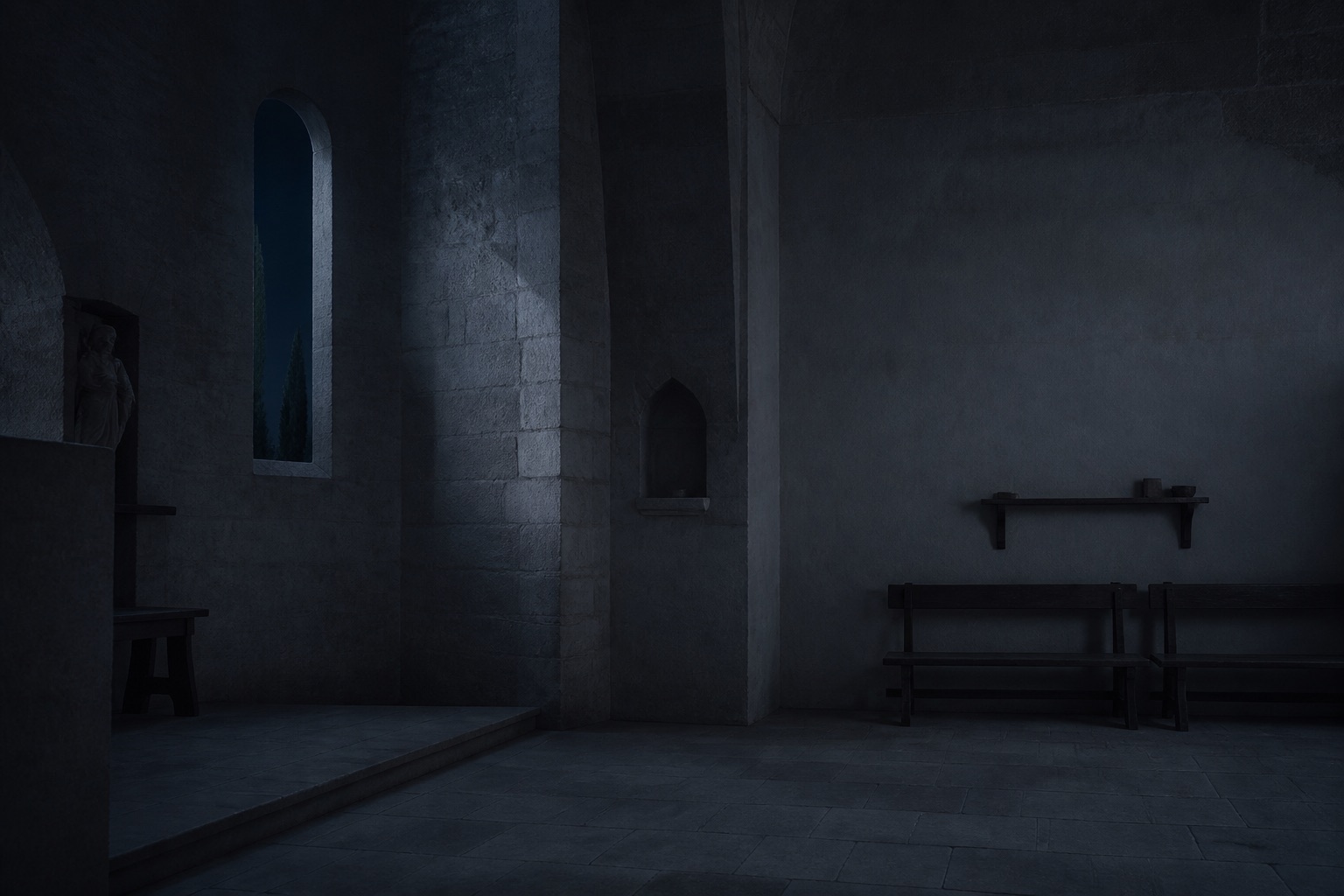
The room remains. The darkness does not explain why it is dark.
NOTICE THE DISTINCTION
The familiar consolation may disappear
while the desire for God remains.
02 · NAME THE MAP, KEEP ITS WORLD
John of the Cross gave one Christian interpretation of such a night.
John wrote for Christians already immersed in a demanding life of prayer. His “dark night” does not simply name the absence of comforting spiritual experience. It names a process of purification in which familiar ways of approaching, experiencing, and even understanding God cease to work as they once did.
For John, the loss has a direction. The person is being drawn toward a less possessive love and knowledge of God—one less dependent on particular feelings, images, insights, or spiritual satisfactions.
The destination matters: John’s Dark Night is ordered toward contemplative union with God.
03 · A PERSON, A PLACE, A THEOLOGICAL AIM
Spain, 1542–1591. A Carmelite life ordered toward union with God.
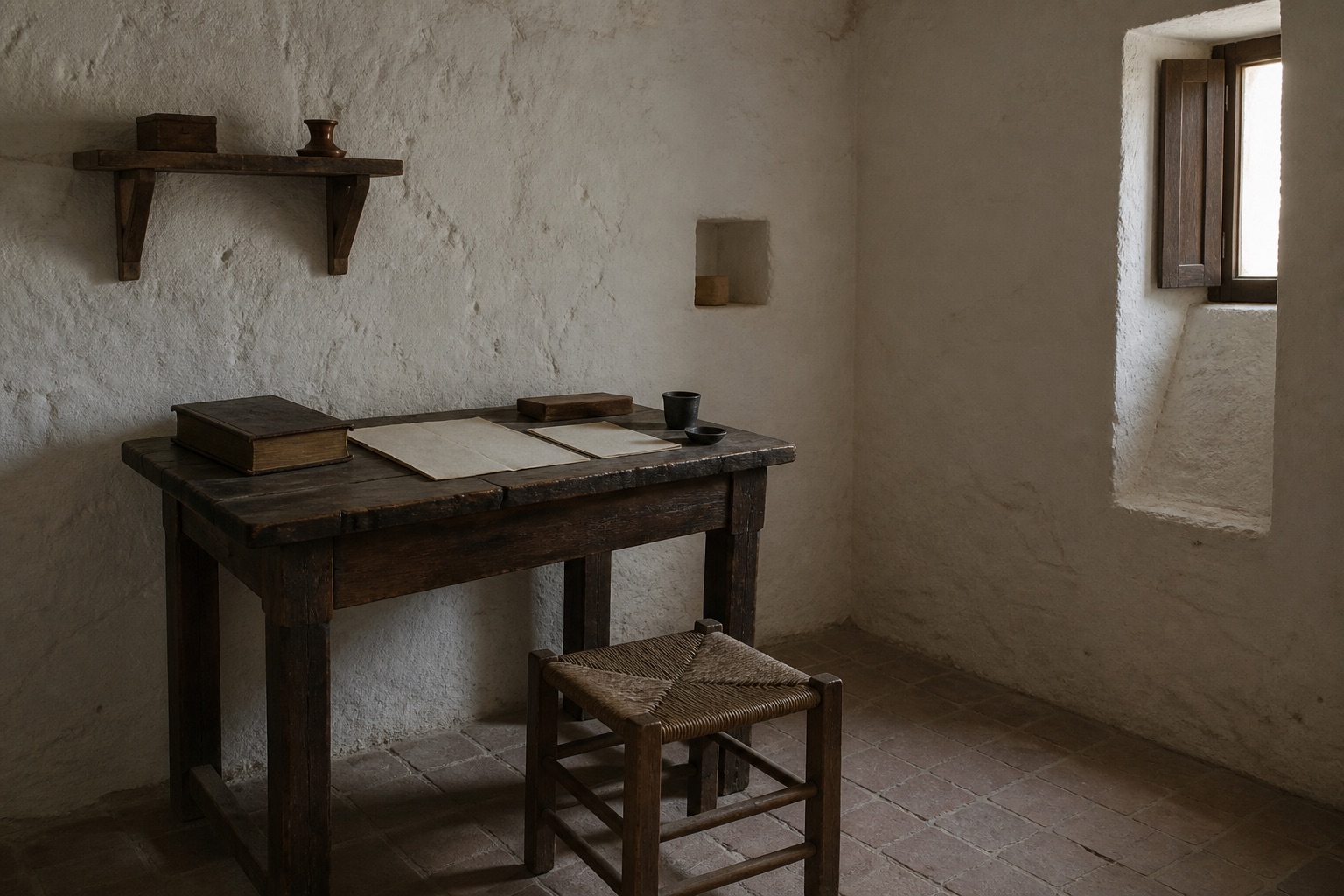
John of the Cross was a Spanish Carmelite friar, poet, reformer, and spiritual writer. His poem The Dark Night and related prose belong to a Catholic contemplative tradition seeking transforming union with God.
Go deeper: active/passive and sense/spirit
John’s account is more precise than the modern phrase “dark night of the soul” often suggests. He distinguishes active nights, involving deliberate practices of letting go, from passive nights, in which purification is received rather than produced. He also distinguishes the night of sense from the rarer and more severe night of spirit.
04 · THREE ANCHORS INSIDE JOHN’S MAP
Relinquishment. Obscurity. Love.
Familiar feelings, images, ideas, and spiritual satisfactions can no longer be possessed as though they were God.
God exceeds the familiar ways a person has learned to perceive and understand God. Not knowing can become part of faith rather than evidence that faith has failed.
The night is not darkness for its own sake. For John, its movement is toward a freer love of God—less dependent on receiving a particular experience in return.
05 · RETURN TO ELENA
Elena is invented for this teaching experience.
John’s Map gives Elena a possibility—not an explanation.
Elena still returns to prayer. The warmth and clarity she once knew have not returned, but neither has her desire for God disappeared.
John offers one way of seeing that experience: perhaps the absence of familiar consolation does not necessarily mean that nothing is happening. Perhaps a relationship with God can change in ways that no longer produce the experiences by which Elena once recognized it.
But the Map cannot tell Elena that this is what is happening to her. Spiritual dryness can have many causes, and no pattern of emptiness proves that someone is undergoing John’s Dark Night.

Something can stop working
without settling what has been lost.
It can also stop working for other reasons.
06 · ONE TEACHING POINT
Desire and consolation are not the same thing.
For John, the loss of warmth, insight, or spiritual satisfaction does not necessarily mean the loss of desire for God. In fact, his account asks whether a person can continue to desire God when the familiar rewards of spiritual practice no longer arrive.
That distinction can illuminate an experience without explaining its cause.
PAUSE · PRIVATE · OPTIONAL
What remains when the familiar spiritual rewards do not?No answer is required. Nothing is saved.
07 · KEEP THE DARKNESS UNDIAGNOSED
This may not be a Dark Night.
Similar feelings can have very different causes.
Severe sadness, numbness, exhaustion, grief, trauma, medication effects, sleep loss, abuse, isolation, or impaired functioning require their own responsible attention.
Suffering is not proof of purification.
Calling an experience a Dark Night does not establish its cause, spiritual value, or destination.
Care must not be delayed.
Danger, abuse, inability to function, self-harm thoughts, extreme sleep disruption, or loss of contact with shared reality call for appropriate medical, mental-health, safeguarding, or crisis support.
John’s Map can offer an interpretation. It cannot diagnose an experience.
08 · RETURN TO ELENA
The name may open a question. It cannot close the inquiry.
Elena can now ask a more precise question. Has her desire for God disappeared—or only the familiar ways she once experienced and expressed it?
John’s Map gives her one way to explore that distinction. But it does not require her to interpret the dryness as divine purification. Grief, exhaustion, changed belief, health, relationships, or other conditions may also deserve attention.
Elena does not need to decide that she is having a Dark Night in order to learn something from John’s way of seeing.
09 · JOHN’S DESTINATION IS NOT HIDDEN
The Dark Night belongs to a particular Christian vision of transformation.
Within John’s account, God acts and grace draws. Attachments that interfere with freer love of God are gradually relinquished. Faith, hope, and love carry the person when familiar ways of knowing and feeling no longer do.
The destination is contemplative union with God.
A traveler can understand John’s account without sharing its theological commitments. But those commitments cannot be removed without changing what John means by the Dark Night.
LOOK THROUGH ANOTHER WINDOW
Lost coordinates may resemble one another.
John interprets the loss of familiar spiritual supports within a Christian process of purification ordered toward union with God.
notices what happens when an old social position or identity has been left behind while a new one is not yet secure or recognized.
The experiences may resemble one another. The Maps make different claims about what the resemblance means.
WHAT TO CARRY FROM THIS WALK
John’s night is not darkness in general.
It is one Christian account of what the loss of familiar spiritual consolation may mean when desire for God remains.
KEEP, COMPARE, OR SET ASIDE
You are free to put this map down.
Understanding it does not require granting its theology or using it to name your experience.