INNER ATLAS MAP
When you’re no longer where you were, but not somewhere new.
Liminality
Arnold van Gennep and Victor Turner · 20th-century anthropology and ritual studies
An 8–11 minute walk
Enter the Map ↓01 · BEGIN WITH THE TERRITORY
Mara no longer knows quite where she belongs.
For years, a community gave Mara more than people to spend time with. It gave her familiar language, practices, relationships, and a place others recognized as hers.
Over time, something changed. Some of what once fit no longer did. Mara gradually stepped back.
But leaving one place did not immediately create another. People from her former community still relate to her as though she occupies her old place. Elsewhere, no new place has quite received her.
This is not only uncertainty inside Mara. Her social world has become uncertain too.
Something has ended.
Something else has not begun.
Mara is a fictional composite.

Neither simply land nor water. The threshold is a place of its own, even when no destination is visible yet.
STAY HERE FOR A MOMENT
An old place no longer holds.
A new place has not received you.
02 · GIVE THE EXPERIENCE A HANDLE
One name for this kind of threshold is liminality.
The word comes from limen, Latin for threshold.
Liminality names the middle phase of a socially recognized passage: a former status has been left behind, while a new one has not yet been conferred.
03 · THREE HISTORICAL ANCHORS
This Map began with people studying rites of passage.

Arnold van Gennep
Van Gennep compared ceremonies surrounding birth, initiation, marriage, death, changes of office, and other shifts in social position.
He noticed a recurring structure:
SEPARATION → THRESHOLD → INCORPORATION
A person leaves or is removed from a former status, passes through an in-between condition, and is eventually received into another.
Latin: threshold
The threshold is not simply a pause between two settled identities.
Ordinary classifications may loosen there. The person is no longer held in quite the old way, but has not yet been publicly received as someone new.
Victor Turner
Drawing partly on his study of Ndembu ritual in what is now Zambia, Victor Turner developed the liminal phase further. He described people in such passages as “betwixt and between” ordinary social classifications.
Go deeper into the historical setting
Van Gennep and Turner were studying structured social and ritual passages—not creating a general psychology of feeling lost.
Later writers carried liminality into pilgrimage, theatre, politics, organizations, migration, disaster, adolescence, and personal change. Those extensions can be illuminating, but they reach beyond the original ritual model.
For a while, the threshold has its own weather.
04 · THE CLASSIC PATTERN
Before. Between. After.
Van Gennep described rites of passage as moving through three broad phases:
This is the classic ritual pattern. Lived transitions do not always complete it. A person may return, remain between positions, or find that no community is waiting to recognize an arrival.
05 · WALK ALONGSIDE
Mara’s transition has no ceremony and no recognized arrival.
Her congregation had known her since childhood. She understood the language, the calendar, the songs, and the expectations. Her family still understood her through the identity she once held, even as that identity no longer fit in the same way.
And there was no obvious new community waiting on the other side.
Mara has experienced something like separation without a clear incorporation. The middle had become more than private uncertainty: her social position has become unsettled too.
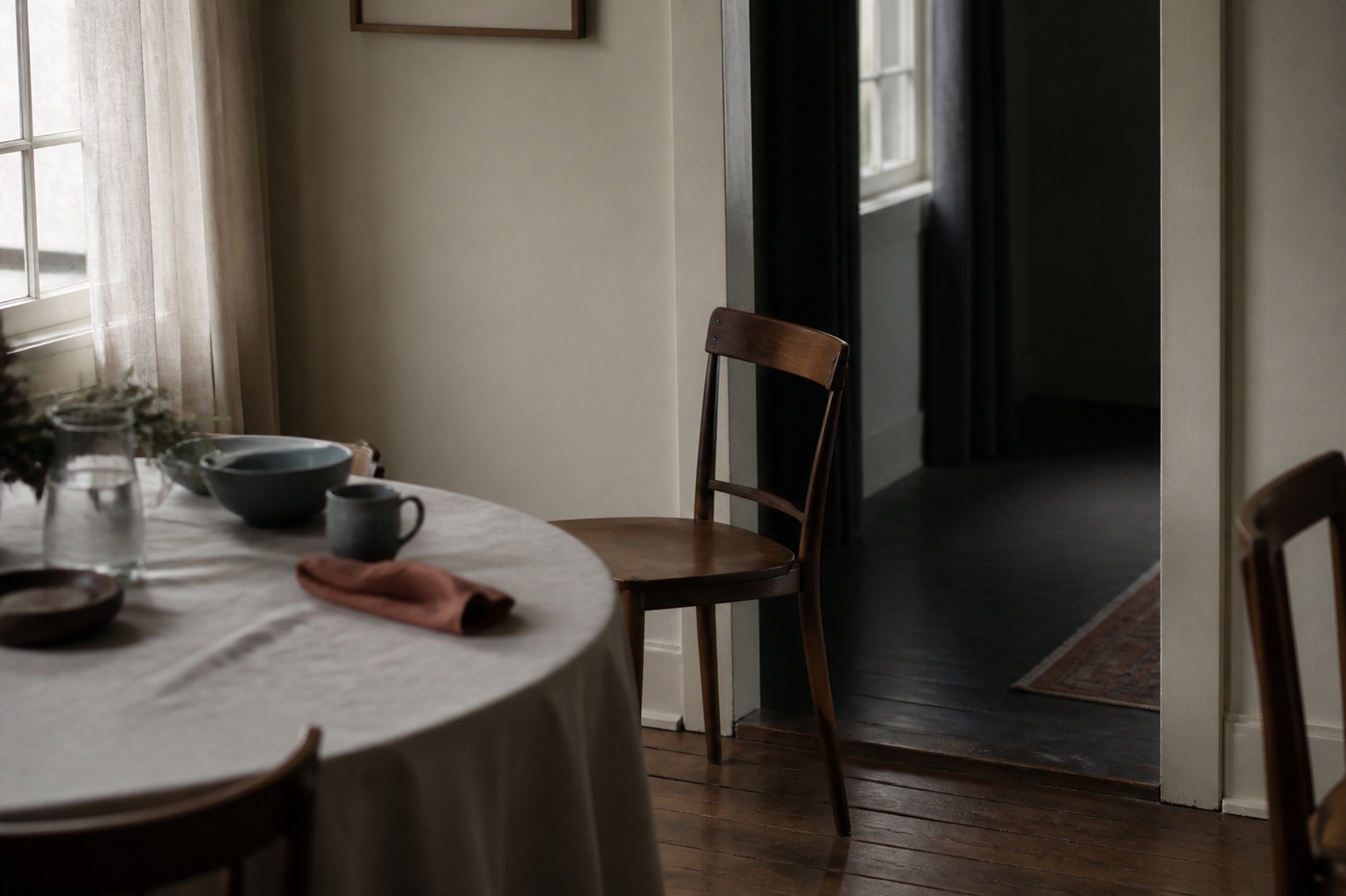
During liminality, the chair feels empty. The only halfway concrete question in this space is: where is a changed person seen to belong?
WHAT THE MAP REVEALS
Mara is not only asking,
“What do I believe now?”
She is also living with:
“Where am I recognized as belonging?”
06 · ONE TEACHING POINT
Transition is social as well as private.
A change within a person can alter relationships, roles, language, practices, and where others understand that person to belong.
Liminality helps us notice that some uncertainty is structural, not merely personal. A person may know that something has changed while the social world around them has no clear way to recognize what has ended—or what comes next.
PAUSE · PRIVATE · OPTIONAL
Who recognizes that something has changed?No answer is required. Nothing is saved.
Who still expects the former role?
What becomes harder when those do not match?
07 · WHEN THERE IS NO RITE OF PASSAGE
Sometimes what is missing is not an answer. It is a recognition.
Traditional rites of passage may provide witnesses, guides, shared words, boundaries, and a public welcome into a new place.
Many modern transitions have no such passage. Something has changed, but there may be no shared way to acknowledge what ended, mourn what was lost, or recognize what is becoming possible.
That absence can leave a person carrying privately what a ritual passage would have made visible together.
WHAT MAY BE MISSING
08 · RETURN TO MARA
The Map explains something Mara could not see from inside the change.
Mara’s beliefs changed gradually. But changing her mind did not automatically change her place among other people.
Some still recognize the person she was. No new community has formally received the person she is becoming. And unlike the rites van Gennep studied, there may be no ceremony, guide, or agreed destination waiting for her.
Liminality helps Mara see that this mismatch is not necessarily evidence that she has failed to move on. Her inward change and her social recognition are moving at different speeds.
But this is also where the Map reaches its edge. It cannot tell Mara what she now believes, promise that another community will appear, or decide whether she should return, leave, remain partly connected, or live without a replacement identity.
09 · COMPANIONSHIP IN THE THRESHOLD
Turner noticed that the in-between can change how people meet one another.
He used the word communitas for a kind of fellowship that can emerge when ordinary ranks and roles loosen. Among people sharing a liminal passage, there may be unusual openness, equality, honesty, or solidarity.
But communitas is not simply another word for community, and it is not guaranteed. People in uncertain places can still reproduce hierarchy, demand conformity, misuse power, or harm one another.
Shared uncertainty does not automatically create wisdom or safety.
A QUESTION THE MAP MAKES VISIBLE
Who has power at the threshold?
Who decides the old role is over?
Who recognizes—or refuses to recognize—what comes next?
10 · LEARN THE EDGE OF THE MAP
Not every in-between is liminal—and not every threshold leads somewhere new.
UNCERTAINTY IS NOT AUTOMATICALLY LIMINALITY
Used too broadly, liminal becomes another word for feeling unsettled. Its distinctive insight is more specific: a person’s place within a social order has become uncertain or is being transformed.
Incorporation is not inevitable.
The classic rite ends with incorporation into a new status. Lived transitions may not. A person may return, remain partly connected, find another place, live across several worlds, or continue without a replacement identity.
The in-between should not be romanticized.
Some thresholds contain possibility. Others are imposed through exclusion, displacement, discrimination, institutional power, or material instability.
Calling such experiences “liminal” must not turn deprivation or exclusion into a spiritually meaningful passage they were never meant to be.
LOOK THROUGH ANOTHER WINDOW
Different Maps notice different things.
notices social position, ritual, recognition, and the conditions of a threshold
notices how a person interprets continuity and change through the stories of a life
Mara’s experience could be viewed through both.
WHAT TO CARRY FROM THIS WALK
Liminality notices the social shape of an in-between time.
It does not require another identity to arrive.
KEEP, COMPARE, OR SET ASIDE
You are free to put this map down.
Understanding enough, listening instead, changing Maps, returning to the Library, or stopping are all legitimate outcomes.